


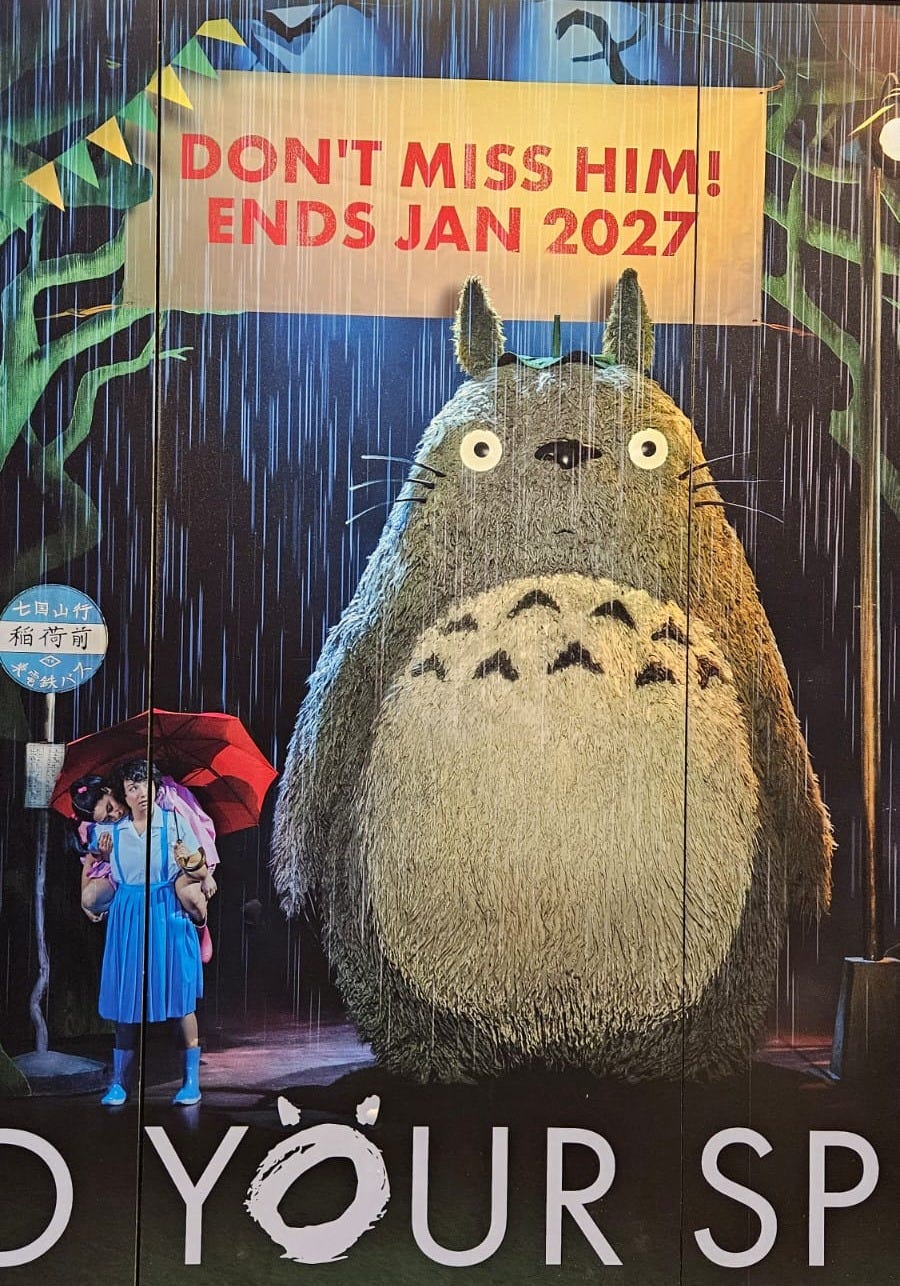
The other day I happened to see My Neighbor Totoro live show in West End.
It has been many years since I’ve seen the animated version, and I only remember the story about two sisters who moved into the rural area and befriended the forest spirits, whom they called Totoro.
A simple story for children and family, and Totoro being cute with their big dead fish eyes and fluffiness.
I was wrong.
The theatre was full of adults and children alike.
Rather, there were more adults than children and it was full house.
The show itself had impressive logistics, music and even adapted for audiences in the UK. It was mainly done in English, with songs in Japanese.
But what was surprising was how it evoked emotions of wonder and fear in me.
Another thing worth noting was seeing how freely Mei and Satsuki (the main characters) expressed themselves. Seeing them running around, the actress who played Mei especially, made me feel energetic too.
I’m also amazed at how the father encouraged them to be children, even laughing outloud to remove fear and invited the girls to do the same.
Now that I’ve been trained in somatic approach, seeing them move, scream and cry felt very apt in releasing trapped emotions. Especially since they were coming to terms with their mother being treated in the nearby hospital.
Okay, enough of the live show’s review.
My intention of writing this piece is to look at Hayao Miyazaki’s Human Design chart.
He is one of the founders of Studio Ghibli, the animation house behind My Neighbor Totoro, Spirited Away, Castle in the Sky, Princess Mononoke, and other titles.
Hayao Miyazaki is an influential figure in the animation world, known for his very disciplined and hands-on style.
It’d be interesting to see him from the Human Design lens and see if there are any elements that support how he showed up in the world.
(Plus, I also consider him as an entrepreneur even if he’s an artist first.)
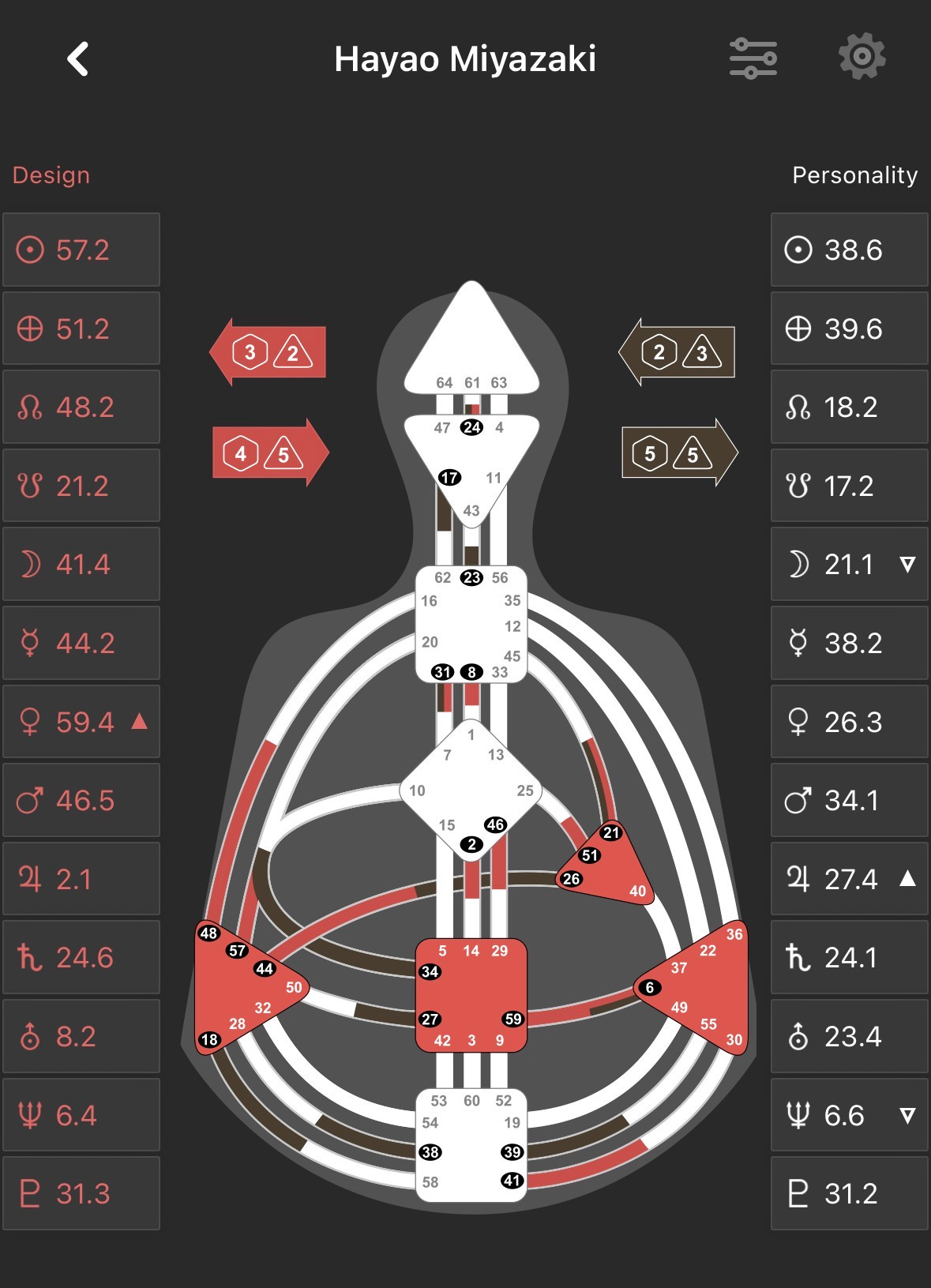
Some points to note before analyzing his Human Design: while his birth date and place are known (January 5th, 1941 in Tokyo, Japan), his exact birth time is not.
I used 12pm as a base and checked earlier and later times.
The main shifts are in his Identity center and profile lines; the themes I explore here are the ones that stay consistent across times.”
Based on what we know about Hayao Miyazaki, I linked it with HD pieces from his chart:
He has a remarkable capacity for sustained work.
Once he’s committed to a project, he can stay with it for very long stretches of time (from 6am to 9pm), often working through fatigue or doubt, as long as he feels genuinely engaged with what he’s making.
In Human Design, Hayao Miyazaki is a Generator, meaning his Sacral centre is defined.
Sacral centre is where our innate energy/vitality stored. With this centre defined, it means he has a steady pace and can sustainably work without being supercharged in one moment and crash in another.
His pace is steady rather than rushed.
Even when the external pressure is high, he tends to build things through persistence and iteration, not quick shortcuts—he’s willing to take the time it takes, refining again and again until it matches his inner standard.
As one of the five types in Human Design that explain how we use our energy in the world, being a Generator means having an internal source of energy that is sustainable, provided the person feels a whole-body excitement in what they’re working on.
His emotional world runs deep and intense.
He doesn’t seem to approach his work from detached logic; feelings like rage, tenderness, disappointment, and awe are all part of what drives him, and they show up both in how he leads and in the stories he tells.
As someone with defined Emotions center, Miyazaki carries emotional depth and may come across as intense.
The emotions he felt may also become a source of energy for him to push through.
He trusts his instinct and gut in the moment.
Rather than following a rigid plan, he often relies on an immediate sense of “this is right” or “this is wrong,” and is willing to change direction quickly when something no longer feels true or alive.
In Human Design, he has consistent instinct (defined Spleen) and gut response (defined Sacral), allowing him to be able to immediately tell what’s right or wrong in the moment.
This is helpful when he has to make decision about productions.
Time pressure affects him strongly.
Deadlines and schedules can become intense forces in his world; at times this translates into very demanding timelines and expectations that can feel unreasonable for those around him, including himself.
Miyazaki is known for being critical and the studio having a demanding time schedule and deadlines (undefined Root centre).
In Human Design, an undefined Root doesn’t mean someone is ‘bad with time’; it means they feel external pressure more strongly and can easily turn that pressure into urgency—for themselves and for others.
Over time, that can become a culture of constant deadlines and intensity, especially in a studio environment.
If there is any piece that needs the most attention, it’d be how his undefined Root influence the time urgency, and became the culture of the studio.
(I’ve linked an article of how Hayao Miyazaki personified Japan’s toxic working culture).
If not communicated properly, this could affect his relationships with his collaborators and may pose risk of burnout.
(That said, there are animators who are loyal to him and his vision despite the demanding nature of the work.)
Hayao Miyazaki comes across as someone with emotional depth, disciplined and has the capacity to work long hours and withstand revisions just to get it ‘right’.
He is also known to be very demanding and perfectionist, sometime even ruthless as commentators and collaborators noted.
You can see all these in his Human Design chart.
Yet despite of the strict working culture, Miyazaki and his team are known to produce animated movies that show green lush natures that feel soft and healing.
From a somatic lens, this contrast is almost archetypal: a body and a studio living inside intense pressure and long hours, and a creative output that keeps returning us to movement, emotion, nature, and the possibility of relief.
His chart, his working style, and the way My Neighbor Totoro invited my own body to feel and release all sit on the same spectrum.
Does Miyazaki’s way of working feel familiar to you in your own business or creative process?
What does your Human Design say about how you relate to time, pressure, and devotion to the work?
If you’re curious to explore this in more depth, Human Design is one of the frameworks I use to help mission‑driven founders understand their own wiring for creativity, decision-making, and sustainable productivity in a 1-on-1 consultation with me for the rest of 2026.